

Fused glass partitions are more than a way to divide space. Within an interior concept, they can act as a subtle accent, a material counterpoint or a piece of architectural jewellery that breaks up uniform surfaces and gives the space a distinctive identity.
Transparency, texture and the way glass interacts with light make it possible to introduce depth without visually closing the interior. A partition can therefore define functions while preserving a sense of openness, light and spatial continuity.
A Material for Intentional Design
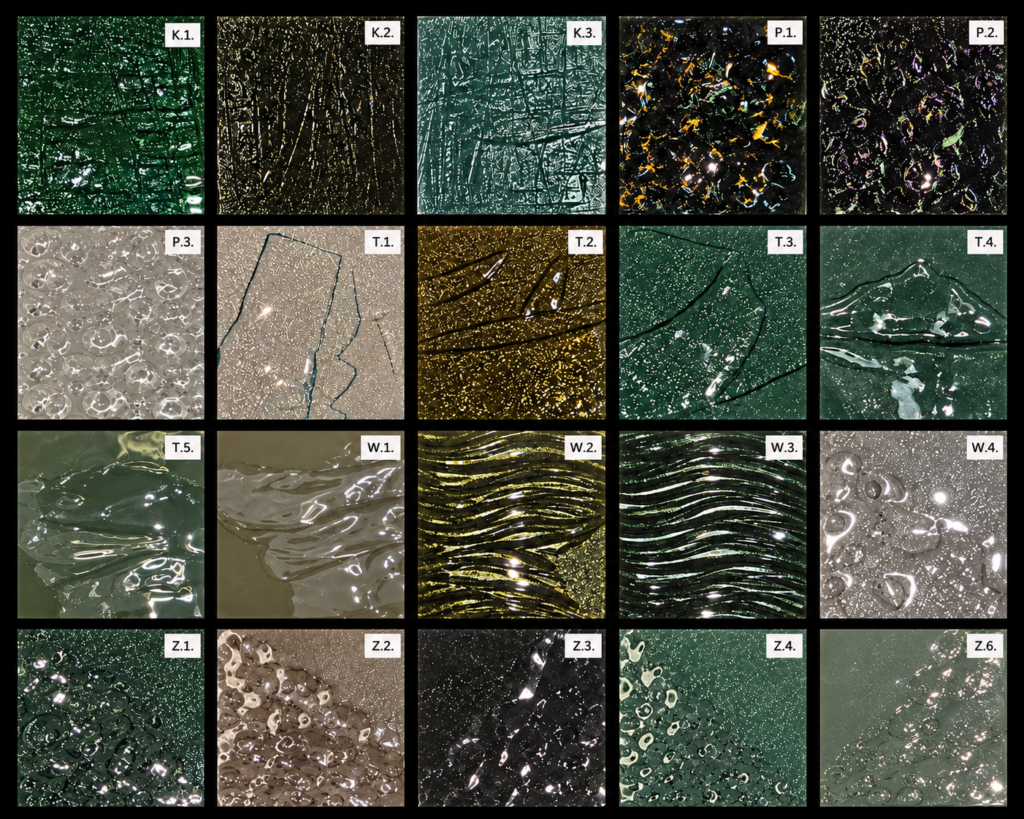
Fusing offers considerable freedom in working with colour, texture, transparency and relief. Individual layers of glass can be composed specifically for a particular interior, its proportions and its material palette.
Glass works naturally with stone, wood, metal, textiles and mineral surfaces. It may serve as a quiet complement to the architecture or introduce a deliberate contrast — light against mass, transparency against solid surfaces, texture against a minimalist background.
Depending on the design concept, it can remain almost neutral or become one of the strongest visual elements in the space.
A Partition as Part of the Composition
Glass screens and partitions are particularly effective where different zones need to be defined without creating a heavy visual barrier. They can be used in hotels, restaurants, residences, spas, clinics, offices and representative commercial interiors.
They can:
- subtly separate functions,
- maintain the flow of natural or artificial light,
- provide privacy without creating a closed feeling,
- introduce a bespoke artistic detail,
- emphasize the rhythm, axis or identity of a designed space.
For Architects and Interior Designers
Each piece can be developed individually in terms of size, colour, transparency, texture and installation method. Glass can also be integrated with lighting, allowing its depth and surface structure to become an active part of the interior atmosphere.
In a well-designed interior, glass does not need to dominate. Often its strongest role is that of a precisely selected detail — an element that completes the composition, breaks material monotony and adds character.
At that point, it becomes more than a partition. It becomes part of the architecture itself.