
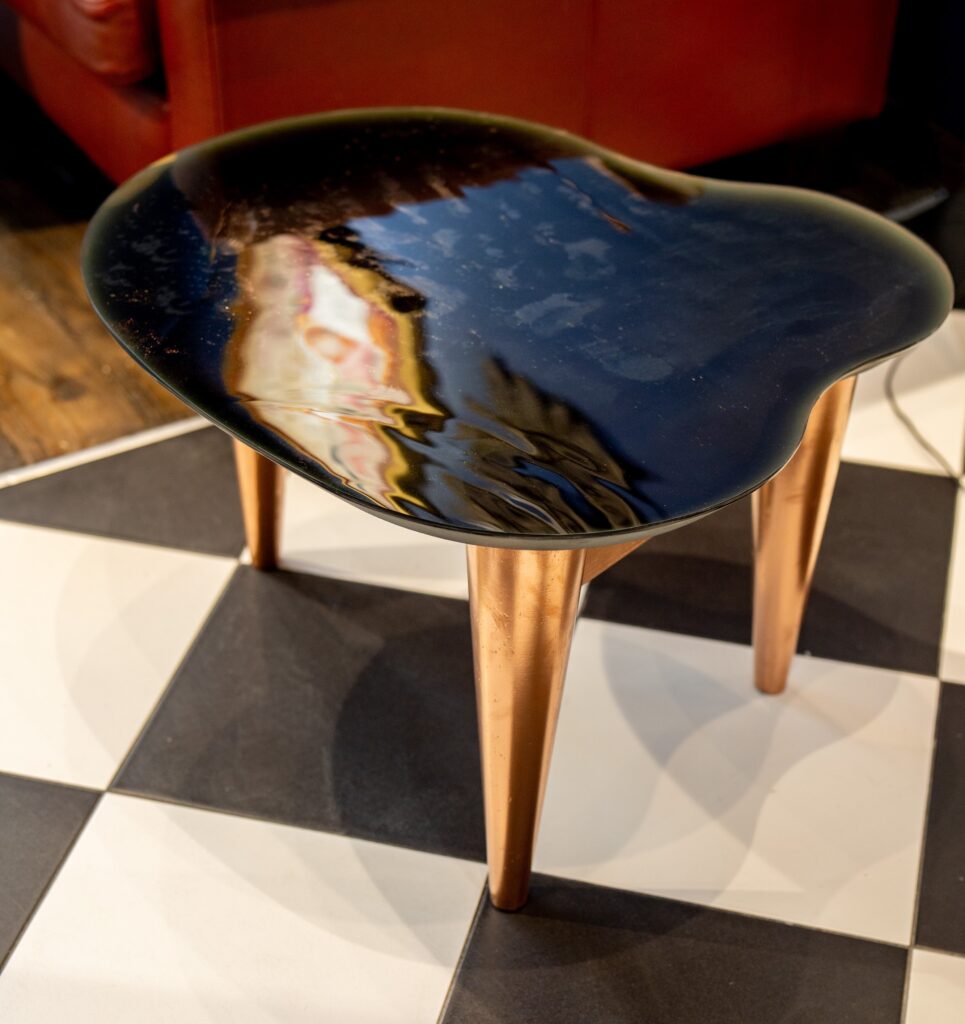
Fused glass tabletops are more than functional surfaces. Within an interior concept, they can act as a distinctive detail, a light material counterpoint or a piece of architectural jewellery that gives furniture and the surrounding space an individual identity.
Through transparency, texture and depth, glass responds to light and changes its appearance depending on the viewing angle and lighting conditions. It can remain a subtle complement to the composition or become one of its strongest visual accents.
A Material for Bespoke Design
Fusing offers considerable freedom in working with colour, transparency, texture, layering and relief. Individual layers of glass can be combined into multidimensional compositions tailored to a specific piece of furniture and interior concept.
Glass works naturally with stone, wood, metal and mineral surfaces. It allows designers to build contrast between mass and lightness, matte and gloss, solidity and transparency.
A tabletop may remain quiet and refined or become an artistic focal point that breaks the material monotony of a space.
Applications in Interior Projects
Fused glass tabletops can be used in both residential and commercial interiors, including:
- dining and conference tables,
- coffee and side tables,
- consoles and display furniture,
- bathroom and vanity tops,
- reception and representative areas,
- shelves, fronts and decorative furniture inserts.
In hotels, restaurants, residences, offices and wellness spaces, they combine a practical function with a distinctive material identity.
Freedom of Form
Precise glass cutting makes it possible to produce tabletops in non-standard and organic shapes. This allows the glass to be adapted to bespoke bases, furniture structures and custom-built elements.
This freedom of form enables architects to treat the tabletop not as a standard product, but as an integral part of a custom-designed piece of furniture.
For Architects and Interior Designers
Each tabletop can be developed individually in terms of size, shape, colour, transparency and surface structure. Glass can also be integrated with lighting to enhance its depth, texture and layered character.
In a well-designed interior, a glass tabletop does not need to dominate. Often its strongest role is that of a precisely selected detail — a complement, a contrast or a piece of jewellery that gives the furniture and the entire space a more individual character.
It is a functional surface that becomes part of the architecture itself.